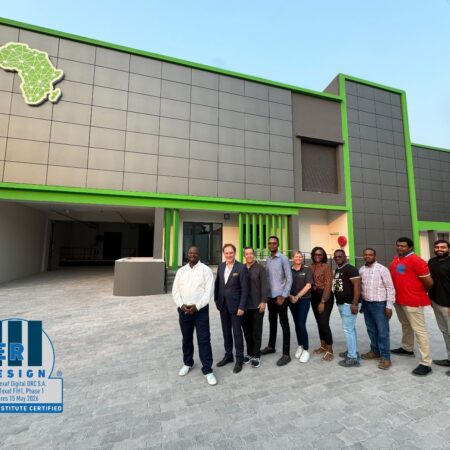

Open Access Data Centres (OADC), Africa’s fastest-growing open-access and carrier-neutral data centre operator, has launched its Open Access Fabric (OAfabric) platform in Nigeria (OADC Lagos) and the Democratic Republic of Congo (OADC Texaf – Kinshasa).
The platform is built to address structural barriers that have long restricted digital transformation in Africa, including:
- Limited access to international and local content
- High internet transit costs
- Latency and inconsistent network performance
- Shortages in colocation, power and cooling infrastructure
- Expensive cloud services and compute environments
- Security, data sovereignty and regulatory complexities
Unlike traditional infrastructure-focused rollouts, OAfabric provides a collaborative interconnection platform where networks, enterprises, content providers and cloud platforms can plug in directly. This approach reduces complexity and cost while enabling high-performance, low-latency, and compliant access to digital services.
“We designed OAfabric around the real challenges African businesses face. It is about solving problems – reducing the cost to compute, improving performance, unlocking access to cloud and content, and creating an environment where companies can scale with confidence while accelerating time to market,” said Dr. Ayotunde Coker, CEO of OADC.
Competitive Landscape
Africa’s data centre market has seen rapid growth, with players like MainOne (now part of Equinix), Teraco (Digital Realty) in South Africa, and Liquid Intelligent Technologies expanding their colocation and cloud connectivity footprints.
- MainOne/Equinix offers global-standard data centre services in West Africa but is often limited to premium enterprise clients.
- Teraco has built one of Africa’s largest interconnection hubs in South Africa, heavily serving hyperscalers and multinational companies.
- Liquid Intelligent Technologies combines pan-African fibre infrastructure with data centre capacity, giving it reach across multiple countries.
OADC’s OAfabric differentiates itself by being purpose-built for carrier-neutral, open-access interconnection, targeting not just hyperscalers and enterprises but also regional ISPs, cloud platforms and local businesses. Its focus on reducing latency, improving regulatory compliance, and enabling direct peering with both local and global ecosystems makes it a strategic alternative in markets where competitors are either limited in reach or more infrastructure-heavy.
Looking Ahead
OAfabric is set to expand into new African markets, extending its reach to deliver enhanced access to cloud ecosystems, international content, and local interconnection hubs. This positions OADC as a serious contender in Africa’s data centre race, bringing much-needed diversity and openness to a sector dominated by a few heavyweight players.